
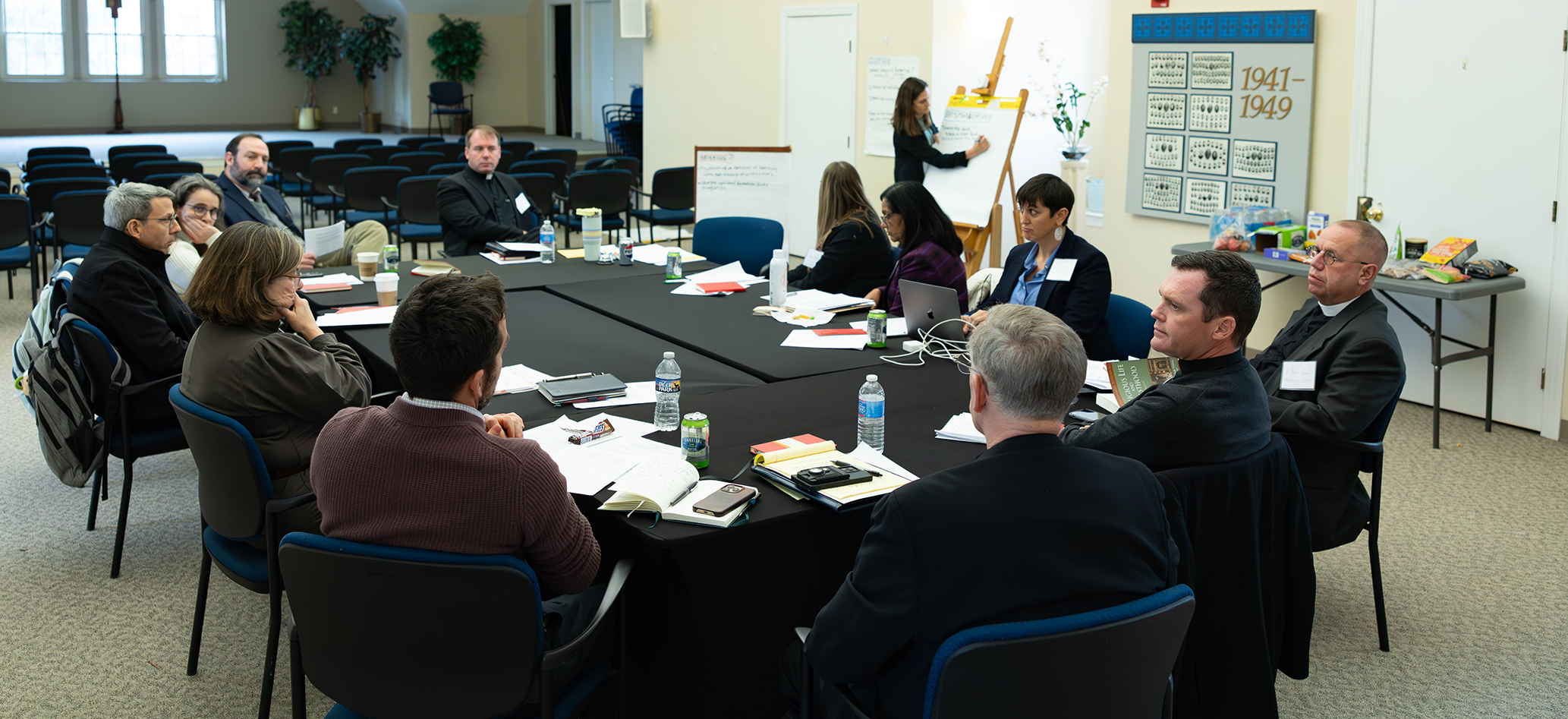
Above, the Pathways for Tomorrow Initiative was launched at the team’s first meeting in Vieban Hall in February.
New Wineskins
Father William J. Kerby is little known today but was a prominent figure in the early days of The Catholic University of America. He joined the faculty in 1898 as its first professor of sociology and became a national leader in the Church’s engagement with the most pressing problems of the day. One of Father Kerby’s interests was offering a vision of the priest needed for the contemporary world. To that end, he suggested that what the Church needed, above all, were “considerate” priests. By this he meant priests who not only had the attributes of sanctity and intelligence, but a capacity to engage in the discernment — that is, consideration — of the actual needs of people living in complex situations and facing the challenges of an ever-changing world. Such a priest would not be governed by rigid adherence to a fixed ideology but instead would be animated by love of Christ and neighbor. Such a priest would communicate pastoral charity in whatever environment he might be placed.
In the upcoming issue of The Crossroads, Dr. Susan Timoney, Associate Dean for Graduate Ministerial Studies, explains the full scope of the Lilly Grant that was recently awarded to the School of Theology and Religious Studies. I would like to highlight what it means for Theological College specifically. The overall purpose of this grant is to enhance our program in pastoral formation. The seminary has long been a pioneer in this dimension of formation, and the grant will allow us to become once again a leader in this endeavor.
The “New Wineskins “program, part of the Lilly’s Endowment’s Pathways for Tomorrow Initiative, is an opportunity for Theological College (along with partner seminaries) to avail itself of the resources that an association with a major university can offer. Through collaboration with the Busch School of Business, the Archdiocese of Washington, and of course the School of Theology and Religious Studies, TC seminarians will receive the education necessary to assume significant pastoral responsibilities soon after ordination. In addition to training in management, finance, and personnel issues, seminarians will be in an environment in which the virtues and disposition necessary for the authentic exercise of spiritual leadership can be fostered.
This is truly an exciting time to be a member of the Theological College community. Our tradition of creative and innovative priestly formation is not only continuing but, I believe, entering a wonderful new chapter. Father Kerby’s dream of a cohort of true priests of Christian consideration is now close to realization. This would not be possible without your prayers and support. May the Lord guide us all forward onto the path before us. Amen.
Father Bud Stevens, Rector